

Datacenter Products List
- TES tanks
Product Categories Menu
Data Center
Heil Trailer Asia delivers specialized mobile and modular data center cooling and storage transport solutions designed to support mission-critical infrastructure.
Data Center
Thermal Energy Storage (TES) steel tanks are specialized containers used to store chilled or heated fluids (like water or molten salts) to shift energy demand to off-peak hours. Choosing between a vertical or horizontal orientation depends primarily on your facility’s spatial constraints and the required thermal efficiency. They are generally categorized as being of a horizontal or vertical architecture.
The choice of orientation (see table below) significantly impacts the tank’s ability to maintain a “thermocline”—the distinct layer separating hot and cold fluids that prevents efficiency loss through mixing.
Thermal Energy Storage (TES) Tanks for Data Centers
Thermal Energy Storage (TES) steel tanks are engineered systems designed to store chilled or heated fluids—most commonly water, but sometimes mediums like glycol or molten salts. Their purpose is to balance energy demand by shifting cooling or heating loads to off‑peak hours, reducing strain on electrical grids and lowering operational costs. In data centers, where cooling is mission‑critical, TES tanks act as a buffer: they store “cold energy” during low‑demand periods and release it during peak loads, ensuring uninterrupted thermal management for servers and IT infrastructure.
Orientation and Architecture
TES tanks are generally built in vertical or horizontal configurations, each with distinct advantages:
Vertical tanks maximize efficiency in limited footprints, making them ideal for urban or high‑density facilities. Their height supports stronger thermocline formation, which improves stratification between hot and cold layers.
Horizontal tanks are better suited for sites with expansive land availability. They offer easier integration with existing piping layouts and can be more cost‑effective at larger volumes.
The choice of orientation is not just about space—it directly influences the tank’s ability to maintain a thermocline, the sharp boundary between hot and cold fluid layers. Preserving this stratification is essential: it prevents mixing, minimizes energy loss, and ensures that stored cooling or heating capacity is delivered at maximum efficiency. A well‑maintained thermocline is the “secret sauce” of TES performance. In data centers, where cooling precision is vital, any blending of hot and cold layers reduces efficiency and forces chillers to work harder. By designing tanks with optimized geometry, insulation, and flow distribution systems, engineers can preserve this thermal layering, extending the usable life of stored energy and reducing operational costs.
View More
Peak Shaving: TES tanks allow facilities to produce chilled water at night when electricity rates are lower, then use it during the day to offset peak demand.
Resilience: In case of chiller failure or grid instability, TES tanks provide a backup reservoir of cooling capacity, protecting servers from overheating.
Sustainability: By reducing reliance on continuous chiller operation, TES systems cut carbon emissions and align with green building certifications.
Scalability: Custom TES tanks can be tailored to match the cooling loads of hyperscale data centers or smaller edge facilities.
Heil Asia’s Offering
Heil Asia now provides consultations for custom TES tanks designed specifically for data center cooling and storage. With expertise in steel fabrication and industrial logistics, the company ensures tanks are engineered to global standards, optimized for thermocline stability, and adaptable to the spatial and operational constraints of modern facilities.
| Vertical Tanks | Horizontal Tanks | |
|---|---|---|
| Footprint | Small; ideal for restricted sites. | Large; requires more surface area. |
| Thermal Performance | Higher due to better natural stratification (layering). | Lower as fluid mixing is harder to prevent in a shallow, wide space. |
| Application | High-capacity district cooling or industrial systems. | Indoor installations or sites with height restrictions. |
| Connection Options | More versatile for complex piping. | Often simpler but limited. |
| Capacity Range | Suitable for all capacities. | Typically used for smaller volumes (9m³ to 30m³). |
Key Components and Standards
- Material: Most tanks are fabricated from Stainless Steel (e.g., SA-240 34700) or carbon steel with protective coatings to resist corrosion at high temperatures.
- Insulation: Essential for preventing heat loss; common materials include aluminum silicate wool or specialized foam layers.
- Diffusers: To prevent mixing, internal diffusers (radial, octagonal, or baffle plates) are installed to ensure “piston flow”—where water moves as a uniform horizontal front.
- Compliance: Look for tanks manufactured to API 650 (welded tanks for oil storage, often adapted for TES), AWWA (water works standards), or ASME pressure vessel codes.
- Reliable Manufacturers
- For specific project requirements, reputable manufacturers include:
Through our supplier partnerships, we are specialists in custom-built TES tanks for data centers and power plants. We offer durable storage solutions for critical infrastructure like data centers, as well as focus on large-scale district cooling plant (DCP) tanks. We integrate ASME-certified pressure vessels suitable for pressurized TES systems.
View Image
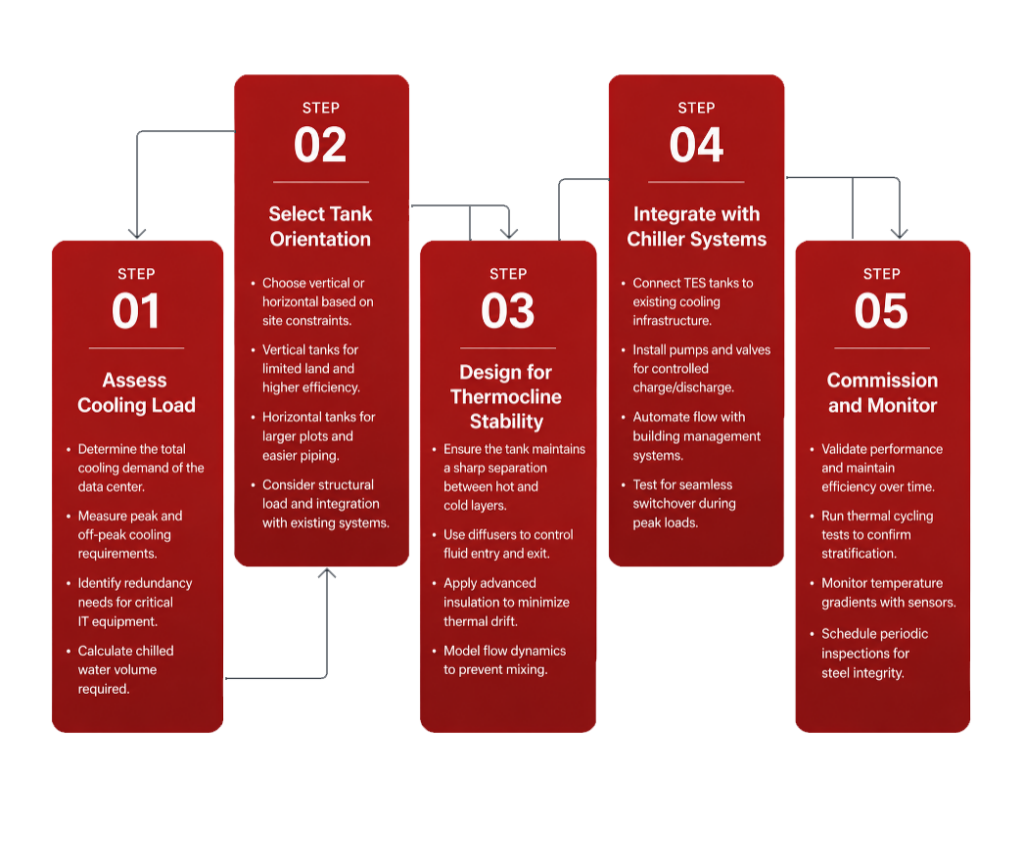
“Guide showing how TES tanks are integrated into data center cooling systems”:
1). Assess Cooling Load
- Start Here, determine the total cooling demand of the data center.
- Measure peak and off‑peak cooling requirements
- Identify redundancy needs for critical IT equipment
- Calculate chilled water volume required
2). Select Tank Orientation
- Choose vertical or horizontal based on site constraints.
- Vertical tanks for limited land and higher efficiency
- Horizontal tanks for larger plots and easier piping
- Consider structural load and integration with existing systems
3). Design for Thermocline Stability
- Critical
- Ensure the tank maintains a sharp separation between hot and cold layers.
- Use diffusers to control fluid entry and exit
- Apply advanced insulation to minimize thermal drift
- Model flow dynamics to prevent mixing
4). Integrate with Chiller Systems
- Connect TES tanks to existing cooling infrastructure.
- Install pumps and valves for controlled charge/discharge
- Automate flow with building management systems
- Test for seamless switchover during peak loads
5). Commission and Monitor
- Validate performance and maintain efficiency over time.
- Run thermal cycling tests to confirm stratification
- Monitor temperature gradients with sensors
- Schedule periodic inspections for steel integrity
Are you looking for a pressurized or non-pressurized system for a specific application, such as a data center or solar plant? Contact Us

“Our TES tanks are enabling the infrastructure behind the digital economy. “